- 033-2552-1334 & 9093085089
- info@gnim.org








HEALTH DEPARTMENT
B.Sc. Medical Imaging Technology
Medical Imaging Technologist
B.Sc. Medical Imaging Technology
Sector: Health Sector
Introduction
Gurukul National Institute and Management offers the B.Sc. Medical Imaging Technology course for candidates who want to build a professional career in the healthcare sector as Medical Imaging Technologists. Medical imaging plays an important role in modern healthcare by helping doctors identify, diagnose, and monitor various medical conditions through advanced imaging procedures.
This course is designed to provide students with theoretical knowledge, practical skills, laboratory exposure, and professional training required to work in hospitals, diagnostic centres, imaging centres, and other healthcare organizations.
One of the major advantages of this program is that eligible candidates can receive comprehensive educational and career-support benefits through Gurukul National Institute and Management, including free course training, free hostel accommodation, a monthly stipend of Rs. 10,000 during the course, and an annual scholarship of Rs. 40,000 for each year of the program, subject to the applicable terms and eligibility conditions.
What is the Course?
B.Sc. Medical Imaging Technology is an undergraduate healthcare program focused on medical imaging procedures and the technology used to produce diagnostic images of the human body.
Students learn the fundamental principles of medical imaging, patient preparation, imaging equipment operation, radiation safety, image quality, patient care, and professional practices. The program combines classroom-based learning with practical and clinical training to help students develop the competencies required for professional work in medical imaging.
After successful completion of the program, candidates can pursue career opportunities as Medical Imaging Technologists and in related healthcare imaging roles, subject to the requirements of the employer and applicable regulations.
Definition and Purpose
Medical Imaging Technology is a healthcare discipline that involves the use of specialized equipment and imaging techniques to create diagnostic images of different parts of the human body.
The primary purpose of the course is to prepare students to assist in the safe and effective performance of medical imaging procedures while maintaining patient safety, professional standards, equipment protocols, and image-quality requirements.
The course also helps students understand how imaging departments function within hospitals and diagnostic facilities and how imaging professionals work as part of a multidisciplinary healthcare team.
Course Curriculum
The B.Sc. Medical Imaging Technology curriculum generally combines fundamental medical sciences, imaging technology, patient care, equipment handling, safety procedures, and clinical training.
The curriculum may include:
Human Anatomy and Physiology
Medical Terminology
Pathology and Basic Disease Processes
Radiographic Physics
Radiation Physics and Radiation Protection
Radiographic Positioning and Procedures
Radiographic Image Processing and Quality
Medical Imaging Equipment and Instrumentation
Digital Imaging Technology
Computed Tomography Technology
Magnetic Resonance Imaging Fundamentals
Ultrasound and Sonography Fundamentals
Contrast Media and Patient Preparation
Patient Care and Communication
Healthcare Ethics and Professional Practice
Hospital and Imaging Department Management
Emergency Care and Basic Life Support
Clinical Training and Internship
The exact subjects and academic structure may vary according to the applicable university, regulatory framework, curriculum, and program requirements.
Subjects Covered
Students may study a combination of theoretical and practical subjects, including anatomy, physiology, pathology, radiographic techniques, imaging physics, radiation protection, digital imaging, CT, MRI, ultrasound fundamentals, patient care, healthcare communication, and clinical practices.
Special emphasis is placed on understanding imaging procedures, operating imaging equipment under appropriate supervision, maintaining safety standards, preparing patients for examinations, and ensuring that imaging procedures are conducted according to established protocols.
Practical Training
Practical training is an important component of Medical Imaging Technology education.
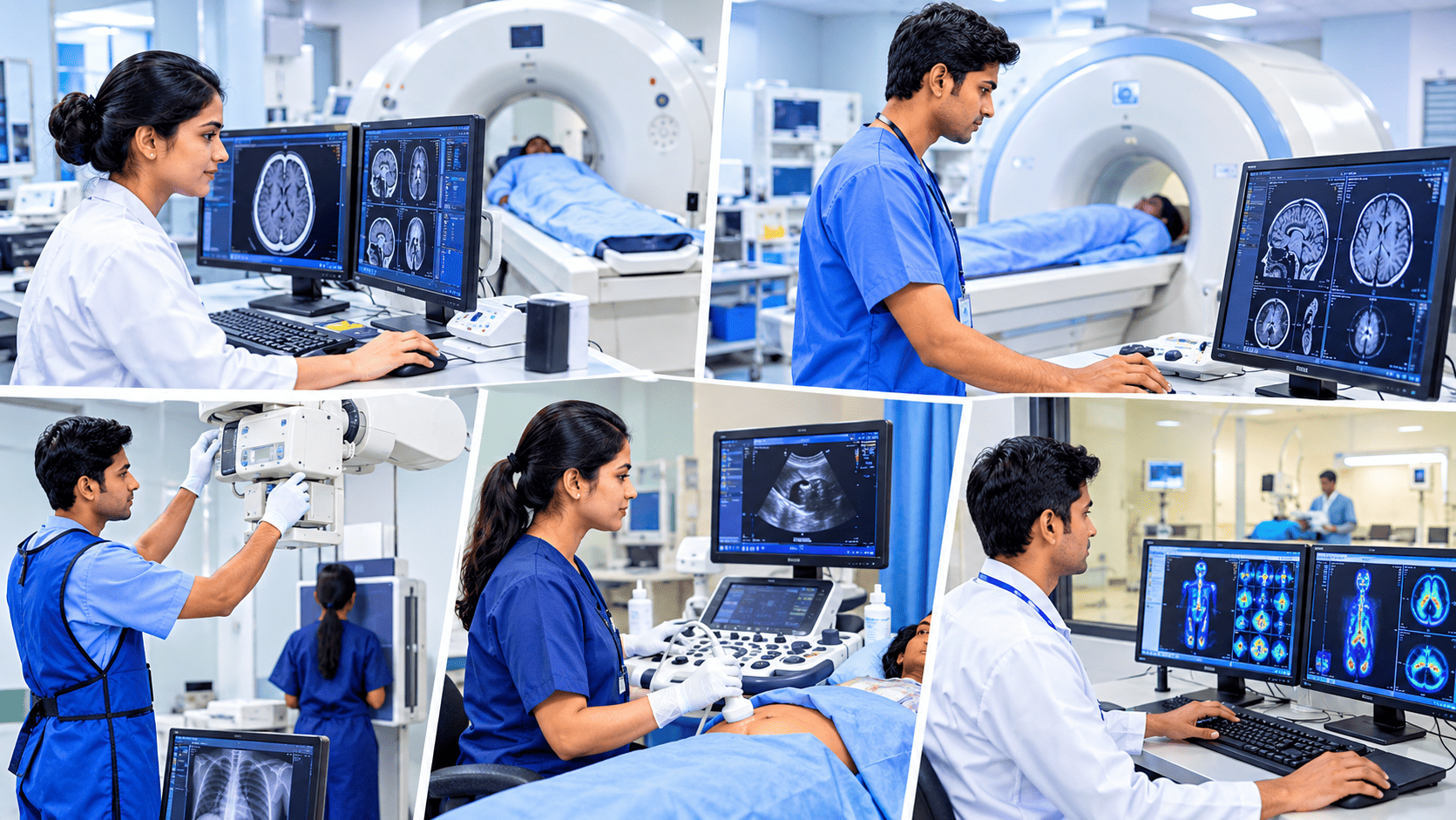
During practical and clinical training, students may receive exposure to:
Radiography procedures
Patient positioning techniques
Imaging equipment and accessories
Radiation safety practices
Digital image acquisition
Image quality assessment
Patient preparation
Contrast procedure assistance
CT imaging workflow
MRI department workflow
Ultrasound department observation
Hospital imaging department procedures
Patient communication and care
Students can develop practical confidence by applying classroom knowledge in controlled laboratory and clinical environments under appropriate supervision.
Eligibility Criteria
Candidates should satisfy the prescribed eligibility requirements for admission to the B.Sc. Medical Imaging Technology program.
Admission may be subject to academic eligibility, entrance examination, document verification, selection procedures, and other applicable requirements.
Candidates are advised to check the current admission notification on the official GNIM website before submitting an application.
Who Can Enroll?
The course is suitable for candidates who are interested in healthcare, medical technology, diagnostic services, hospital environments, and scientific applications in medicine.
Candidates who have an interest in medical imaging equipment, technology, patient care, and diagnostic healthcare services can consider this program as a potential career pathway.
Age Limit
The applicable age limit will be determined according to the admission rules and program requirements in force at the time of admission.
Candidates should check the current admission notification published through the official GNIM website for the applicable age criteria.
Educational Qualifications
Candidates should generally have completed the required higher secondary education, preferably with the relevant Science subjects, from a recognized educational board or institution.
The exact subject requirements, minimum marks, equivalency requirements, and other academic conditions may depend on the applicable university or program regulations.
Candidates should verify the current eligibility requirements before applying.
Benefits of the B.Sc. Medical Imaging Technology Course
Gurukul National Institute and Management provides several important benefits to eligible candidates under the applicable program terms.
Completely Free Course
The course is offered completely free of charge to eligible selected candidates, subject to the applicable terms and conditions.
Free Hostel Accommodation
Free hostel accommodation is provided to eligible candidates, helping students who need residential facilities during their course.
Monthly Stipend of Rs. 10,000
Eligible students can receive a monthly stipend of Rs. 10,000 during the course, subject to the applicable terms, attendance requirements, eligibility conditions, and program rules.
Annual Scholarship of Rs. 40,000
An annual scholarship of Rs. 40,000 is provided for each year of the program to eligible students, subject to the applicable scholarship conditions.
Employment Opportunity After Completion
Students completing the required training and successfully fulfilling the applicable course and selection requirements can receive employment opportunities through GNIM's placement-support arrangements.
Employment is subject to successful course completion, candidate eligibility, employer requirements, selection procedures, and applicable terms.
Career Opportunities
After completing B.Sc. Medical Imaging Technology, candidates can explore opportunities in healthcare organizations and diagnostic services.
Potential career roles may include:
Medical Imaging Technologist
Radiology Technologist
Radiographer
X-Ray Technologist
CT Technologist
MRI Technologist
Imaging Department Technician
Diagnostic Imaging Technologist
Healthcare Imaging Assistant
Candidates may find opportunities in hospitals, diagnostic centres, imaging centres, medical institutions, and other healthcare organizations, depending on their qualifications, specialization, experience, and employer requirements.
Skill Development
The course can help candidates develop a combination of technical, clinical, and professional skills.
Students can develop skills in:
Medical imaging procedures
Patient positioning
Medical imaging equipment handling
Radiation safety
Image quality management
Digital imaging systems
Patient preparation
Patient communication
Healthcare documentation
Hospital procedures
Professional ethics
Workplace safety
Teamwork and communication
Clinical workflow management
These skills can help students adapt to the professional environment of hospitals and diagnostic imaging departments.
Why Choose GNIM for This Course?
Gurukul National Institute and Management focuses on connecting eligible candidates with structured education and career opportunities in different professional sectors.
For the B.Sc. Medical Imaging Technology program, prospective candidates can benefit from:
Completely free course opportunity
Free hostel accommodation
Monthly stipend of Rs. 10,000 during the course
Annual scholarship of Rs. 40,000 for each year of the program
Practical and career-oriented training
Healthcare-sector career opportunities
Placement support
Guidance throughout the admission process
The combination of education, practical exposure, financial support, accommodation, and career assistance can help eligible students pursue a structured pathway toward a career in medical imaging.
Placement Confirmation
Gurukul National Institute and Management offers career and placement support by maintaining collaborative relationships with leading government-recognized organizations.
Eligible candidates who successfully complete the required course and satisfy the applicable selection criteria may receive employment opportunities through the placement process.
Placement opportunities may vary depending on the candidate's qualification, course completion, performance, vacancies, employer requirements, selection procedures, and applicable rules.
Candidates should therefore consider the placement support as an opportunity facilitated through GNIM's collaborative network rather than as an unconditional employment guarantee.
How to Enroll / Admission Process
Admission to the B.Sc. Medical Imaging Technology course is conducted through the prescribed online application and selection process.
Candidates should follow the official admission instructions provided by Gurukul National Institute and Management.
Only our official website: www.gnim.org
No offline application has been received.
Candidates should use only the official GNIM website for submitting their application and obtaining current admission information.
Application Procedure
Interested candidates can apply online through the GNIM website.
Visit the official website of Gurukul National Institute and Management.
Go to the relevant admission or course section.
Select the B.Sc. Medical Imaging Technology course.
Read the eligibility requirements and admission instructions carefully.
Complete the online application form with accurate information.
Upload the required documents, wherever applicable.
Submit the application online.
Follow the subsequent instructions regarding examination, selection, verification, and admission.
Candidates should keep their application details and supporting documents available for the subsequent admission process.
Conclusion
B.Sc. Medical Imaging Technology is a career-oriented undergraduate program for candidates interested in medical imaging and healthcare technology. The program combines academic education with practical and clinical exposure to help students develop the technical and professional skills required in medical imaging environments.
Through Gurukul National Institute and Management, eligible selected candidates can access significant educational and financial benefits, including a completely free course, free hostel accommodation, a monthly stipend of Rs. 10,000, and an annual scholarship of Rs. 40,000 for each year of the program, subject to the applicable terms and conditions.
Candidates who successfully complete the program can explore employment opportunities in hospitals, diagnostic centres, imaging facilities, and other healthcare organizations through the available placement-support process.
Call to Action
Interested candidates are encouraged to visit the official GNIM website and apply online.
Official Website: www.gnim.org
Contact: +91 9093085089
WhatsApp Available
Apply online and take the next step toward building a career in Medical Imaging Technology with Gurukul National Institute and Management.
Our Gallery


Our Course Collaborating Institutes


Our Placement Collaborating Organization


.png)
.png)
.png)
.jpg)

.jpg)